Fragile and Temporary: Images of Vulnerability in Contemporary Irish Experimental Cinema
In recent years, Irish experimental filmmakers have turned their cameras toward the fragile, the temporary, and the uncertain. Their works explore themes of vulnerability, risk, and instability—forces that resonate with our contemporary moment of ecological crisis, social upheaval, and personal uncertainty. This is not a cinema of answers. It is a cinema of questions, of atmospheres, of half-remembered dreams.
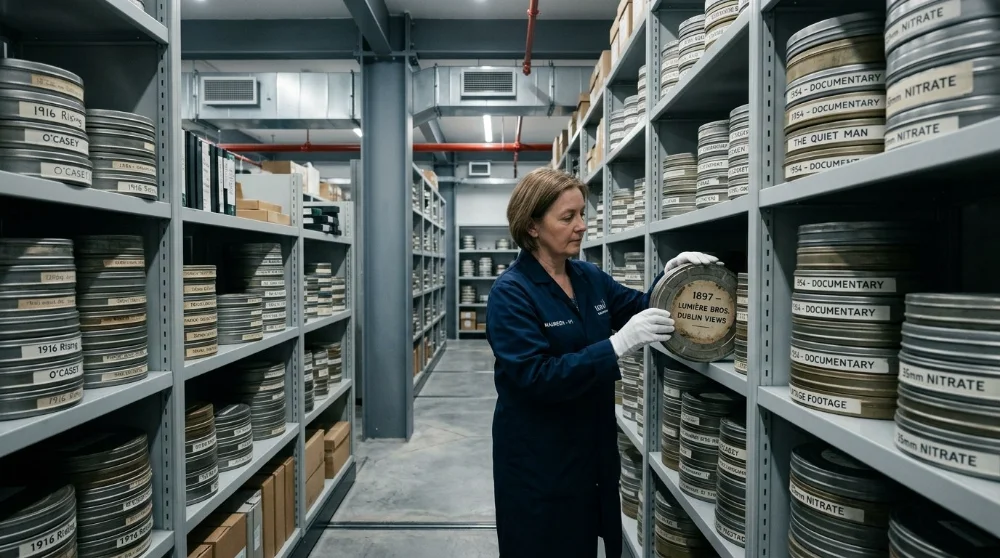
At the heart of this movement is MExIndex, the Irish Artists’ Film Index, itself founded by visual artist Fifi Smith in 2016 . The Index serves as a resource for curators, researchers, and artists, documenting visual arts-based moving image works that address Irish history, politics, culture and society . It is a living archive of our collective fragility.
The Architect of Fragility: Fifi Smith
Fifi Smith, a visual artist living in Celbridge, Co. Kildare, began her career as an architect before turning to art in 1995 . This background in structure and space is evident in her work, which often explores “the shifting balance between emotion and reason in human behaviour” . Her current practice encompasses large-scale light and kinetic installations, bronze and steel sculpture, and experimental film .
Her film work, which includes Embedded Future (2020), Anthropomorphic Anomalies (2019), and her most recent piece, Impressions of Recovery (2025), uses “collages of experimental footage often treated with special effects and some animation” . These works examine the tension between mass behaviour and individuality, human motivation, and the fragile structures we build to contain our lives. Smith’s work has been shown internationally—in Barcelona, Bucharest, Beijing, Washington DC, and across Ireland—demonstrating the global resonance of her vision .
The Ghost in the Machine: Michael Higgins’ At One Fell Swoop
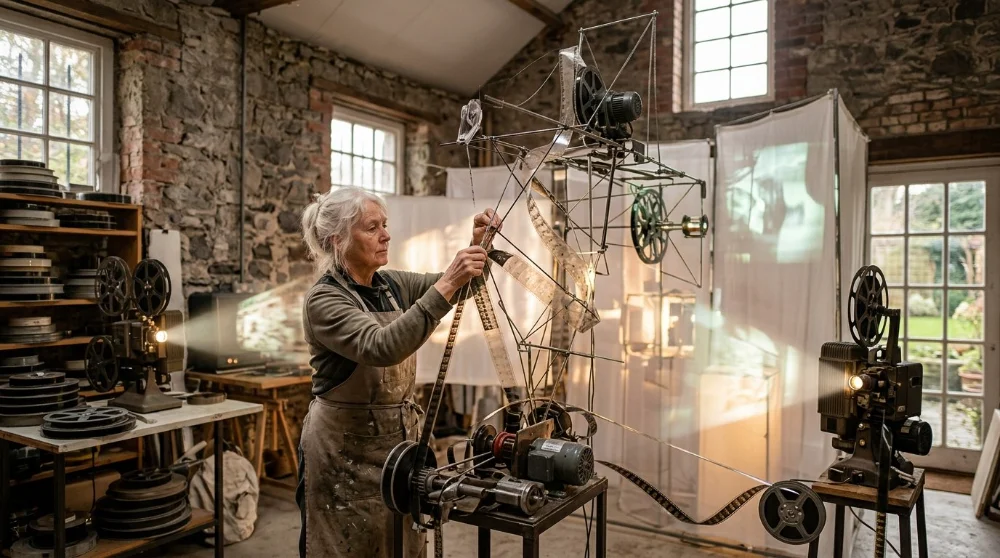
Michael Higgins is an Irish underground filmmaker whose work embodies the very idea of cinematic fragility . His notable piece, At One Fell Swoop (2015), was created using a 50-year-old wind-up camera and expired 16mm black-and-white film, which he hand-processed himself .
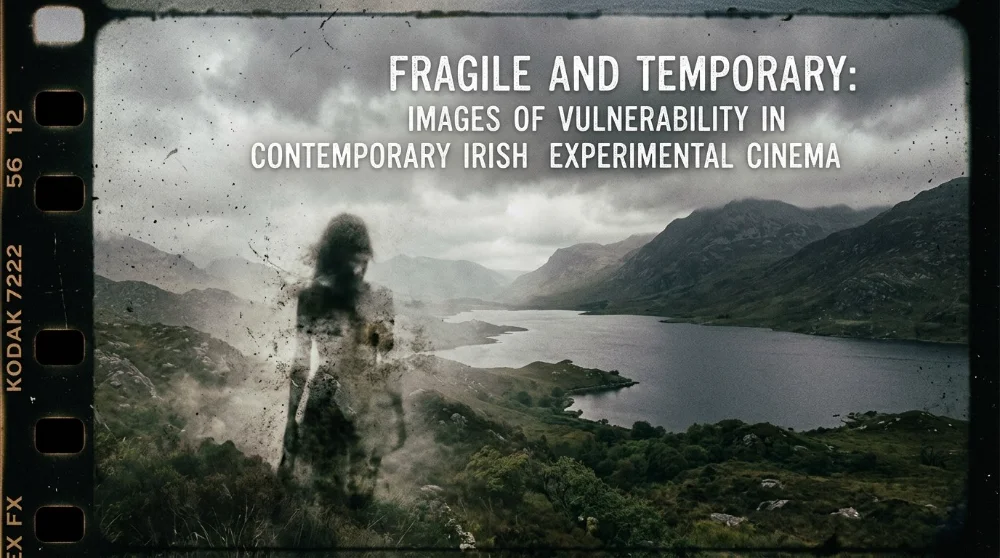
The result is described as the “closest thing to a ‘ghost film'”—not a film about ghosts, but a film that is a ghost . Its spectral quality, appearing as a “patinated, ahead-of-its-time artifact of the Silent Era,” is reason enough to seek it out . The film takes viewers on a “mind-altering journey through time and space, across the misty subconscious periphery of an unnamed hero”—a stone carver who may be the artist’s alter ego .
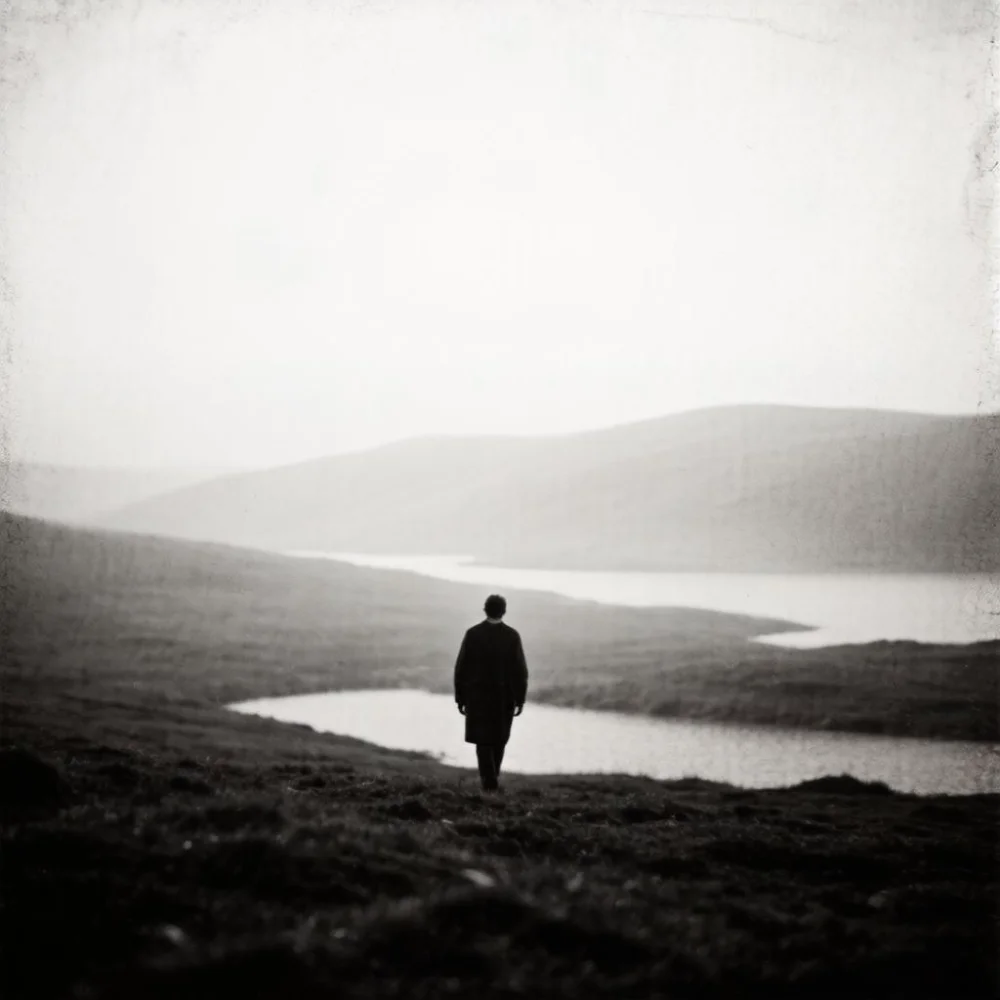
Set in the hills, lakes, fields, and forests of rural Ireland, the landscape itself becomes abstract and gauzy, turned into “dense shadows or oneiric stupor” . The film is steeped in “unsentimental nostalgia, mythical mysteriousness and progressive thought” . It is, in essence, a meditation on searching for essence, for meaning, in a world that offers none.
The Disappearing Self: Kevin Gaffney’s Everything Disappears
Kevin Gaffney’s Everything Disappears (2014) offers a different kind of fragility—one rooted in identity and performance . The film revolves around four people from Taiwan who answered an open call to participate in a project exploring “ideas of self-image, performance and identity” .
The work unfolds across seven chapters in Taiwanese cityscapes and intimate portraits, mediating “an exchange between reality, reconstruction and mythological imagination” . The central chapter, The Elephant on the Roof, tells the story of a young gay man who fakes mental illness to escape military conscription—and then loses his grip on reality entirely .
This is a film that asks how we perform our identities, how we reconstruct ourselves for others, and what happens when the performance collapses. The title itself—Everything Disappears—is a stark reminder of impermanence.
A World of Promise and Peril: Ailbhe Ní Bhriain’s An Experiment with Time
Ailbhe Ní Bhriain, born in Clare in 1978 and working in Cork, brings a distinctive voice to this conversation . Her installation An Experiment with Time (2022), inspired by J.W. Dunne’s 1927 book on serial time, explores “our current relationship with past and future, which has been deeply disrupted by the urgent climate threat, mass extinction and pandemic” .
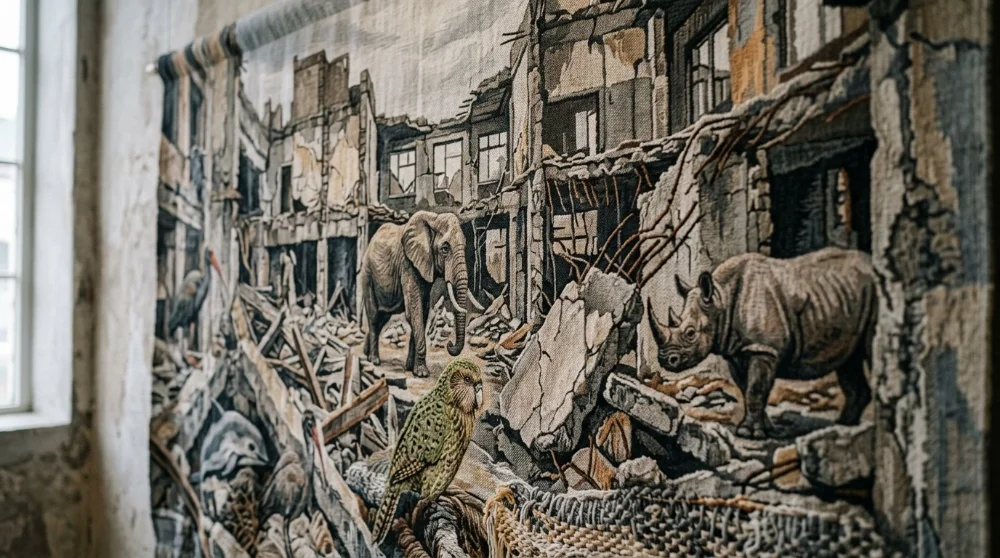
Using live-filmed sequences and imagery generated by computer and AI, Ní Bhriain re-imagines “sites from medical, technological and religious history in terms of a dreamlike theatricality” . Her Jacquard tapestries depict “architectural ruins—excavated Irish landscapes and damaged urban sites, populated with animals that are already or soon-to-be extinct” . The ensemble reveals “an enigmatic world, redolent of the uncertainty, contradictions and fragility of our planet today” .
The Fever Dream: Andrew Keogh’s Mismantler
Andrew Keogh’s Mismantler, which premiered at the Cork International Film Festival, represents the dark frontier of Irish experimental film . Described as a “fascinating and deeply unsettling experiment in audiovisual immersion,” the 79-minute feature unfolds as a “dark, stream-of-consciousness fever dream” that defies conventional storytelling .
The film emerged from a collaboration between Keogh and the experimental music collective Nurse With Wound . Its visual identity is “layered” and “fractured,” dominated by a palette of “rust, red and orange” that evokes “scorched earth, oxidised metal and dried blood” . There is no narrative anchor. Instead, the audience is “submerged in sensory overload” .
Mismantler is described as “an act of exposure, an open wound projected in moving images” . It offers no answers, only an experience—one that demands “surrender, rather than interpretation” .
Conclusion
Contemporary Irish experimental cinema is marked by a profound engagement with fragility. Whether through the hand-processed ghosts of Michael Higgins, the disappearing selves of Kevin Gaffney, the dreamlike ruins of Ailbhe Ní Bhriain, or the fevered descent of Andrew Keogh, these filmmakers are creating a cinema that does not flinch from vulnerability.
They find beauty in decay, meaning in uncertainty. Their work is not about providing comfort or answers. It is about asking questions—about identity, about environment, about our place in a world that seems increasingly unstable. And in doing so, they create a powerful and necessary art for our time.