I. The Documentary Impulse, Reimagined
The word “documentary” has always made people expect certain things—like being objective and showing the truth as it is. But, as a new generation of Irish artists shows, the most interesting documentary work today is not about recording reality, but about questioning how reality itself is constructed. These are filmmakers who work in what might be called the cinema of the real. This is a space where the lines between the documentary and the experimental, the personal and the political, are deliberately mixed up.
The movement is led by Holly Márie Parnell, an Irish-Canadian artist. Her work is a deep meditation on how we express meaning and value through authority and language. Her work, which includes moving image, expanded cinema and installation, is based on her own experiences and is driven by what she describes as “the subtle yet powerful truths of embodied knowledge and lived experience”.
II. The Intimate Lens: Holly Márie Parnell’s Cinema of Care
Parnell’s way of making films is based on a documentary style, but on a very personal level. She makes music from pieces of everyday life. These are things like videos and sounds she has collected over many years. She then puts them together using rhythm, arrangement and composition. This is not just reporting the facts; it is like digging up old memories.
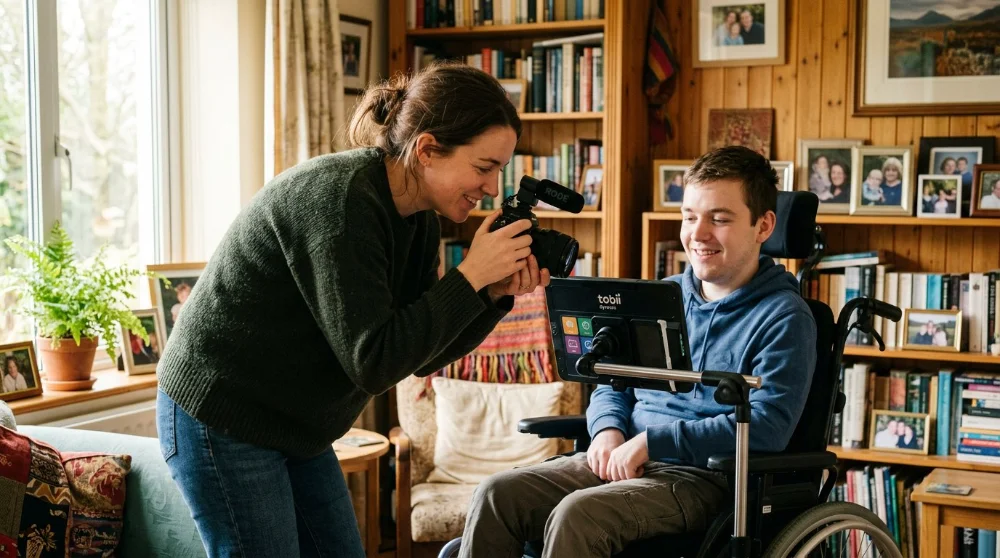
Her film Cabbage (2023) is a good example of this. She made the film with her family. It looks at how people look after each other. It is about her brother David. He cannot speak or move. His mother is his main supporter and speaks for him. The film is set in the months before the main characters move back from Canada to Ireland. They had to leave Ireland ten years ago because there were not enough disability services.
What makes Cabbage so remarkable is its refusal to adopt a conventional documentary structure. There is no narrator who knows everything, and there is no voiceover to explain what is happening. Parnell’s approach is not straightforward. Instead, he uses a non-linear framework, which means he combines fragments of conversation, reflection and the quiet, often overlooked details of care. David uses special technology to type what he wants to say. This technology lets him type with his eyes. He uses this technology to write poetry and take photographs. The film is less about disability and more about how disabled people are judged and valued in a world that values ability.
As Parnell has said, her work is based on “the in-between moments, the things that are not fixed or complete — these limbo spaces”. She suggests that new meanings can emerge in these spaces – meanings that are more sensory, more deep-rooted, and more in tune with the complexities of real life.
III. The Politics of Language and Authority
At the heart of Parnell’s work is a long-term investigation into language and power. Her work asks: How do the structures of government and organisations affect our ideas about what matters most? How do people’s voices—or the lack of them—affect their ability to make decisions and their worth?
In Cabbage, these questions are explored through the lens of family and disability. But they appear again and again in her work, including her ongoing Desktop Compositions series. This series uses digital tools like Instagram filters, YouTube tutorials, dating apps and wearable eye trackers to explore changing ideas about bodily freedom in today’s world.
This interest in language and authority is also seen in her other work. As she has explained, her work often looks at how we measure and value human life using language. This is not just an idea; it is based on real experiences. This is very different from earlier generations of documentary filmmakers, who often tried to be neutral. For Parnell, the filmmaker is an active participant, which means he is involved in the relationships and dynamics being explored.
IV. A Broader Context: Irish Documentary’s Rich Tradition
Parnell is one of a group of Irish artists who are combining documentary and experimental styles. This is a very old tradition. It started with Vivienne Dick’s No Wave films, which helped define a generation of feminist experimental filmmaking. Then there’s Pat Collins’s formally audacious work, such as Song of Granite (2017). This blended fictional recreation, archive footage, and musical performance to create an impressionistic portrait of folk singer Joe Heaney.
More recently, the documentary Guggi (2026) by Ian Thuillier has made people think again about what is possible in the art of portraiture. The film was made over two years and gives the viewer special access. It shows Guggi’s journey from the wild post-punk world of 1980s Dublin to his quiet life as a painter. But it doesn’t follow the usual structure of a traditional biography. Instead, it offers a thoughtful look at creativity, friendship and how people can overcome challenges. As Thuillier said, he wanted to make a film that was more than just the story of an artist. He wanted to explore the human need to create.
These different practices have one thing in common: they all want to challenge the very idea of what a documentary is. These films don’t just show us the world; they make us think about how we see things, how we know what we know, and how we judge what is valuable.
V. The Audience as Co-Conspirator
One of the most striking things about Parnell’s work is her connection with the people who come to see it. She is clear that her work is not designed to make anyone do anything. “You can’t control what people will feel or not. “I just use my own reactions and feelings to guide me.”
She likes to feel close to the work and easy to get to. She likes to be able to see it on her phone from her bed. This doesn’t mean the work is any less important. It just means that the most meaningful experiences with art often happen in simple, everyday places. It is a way of thinking that goes well with her interest in things that are incomplete, things that are not finished, and things that are happening now.
VI. A New Language for a New Reality
Holly Márie Parnell is a very important new voice in Irish documentary filmmaking. Her work, and that of her contemporaries, signals a shift away from the traditional documentary’s claims to objectivity (being impartial) and towards a more personal and politically engaged mode of filmmaking.
Her approach is based on her own experiences and is committed to exploring the different meanings of language and authority. This approach offers a new type of film that is realistic and understands the difficulties of modern life.
It is a cinema that does not claim to have all the answers, but instead encourages us to ask better questions. This makes us remember that the most powerful truths are often found not in the big stories we make, but in the small parts, the moments in between, and the voices that come from outside the picture.