Voices from Beyond the Frame
I. The Documentary Impulse, Reimagined
The term “documentary” has long carried with it a certain weight of expectation—a promise of objectivity, of truth captured unvarnished on film. Yet, as a new generation of Irish artists demonstrates, the most compelling documentary work today is not about recording reality, but about interrogating how reality itself is constructed. These are filmmakers who work in what might be called the cinema of the real, a space where the boundaries between the documentary and the experimental, the personal and the political, are deliberately blurred.
At the forefront of this movement is Holly Márie Parnell, an Irish-Canadian artist whose practice offers a profound meditation on how we impart meaning and value through layers of authority and language . Her work, which spans moving image, expanded cinema, and installation, is built from personal encounters and driven by what she describes as “the subtle yet powerful truths of embodied knowledge and lived experience” .
II. The Intimate Lens: Holly Márie Parnell’s Cinema of Care
Parnell’s approach to filmmaking is rooted in a documentary method, but one that operates at an intimate, almost cellular level. Her work is constructed from fragments of daily life—footage and field recordings gathered over years—which she then reshapes through rhythm, arrangement, and composition . This is not reportage; it is a form of poetic excavation.
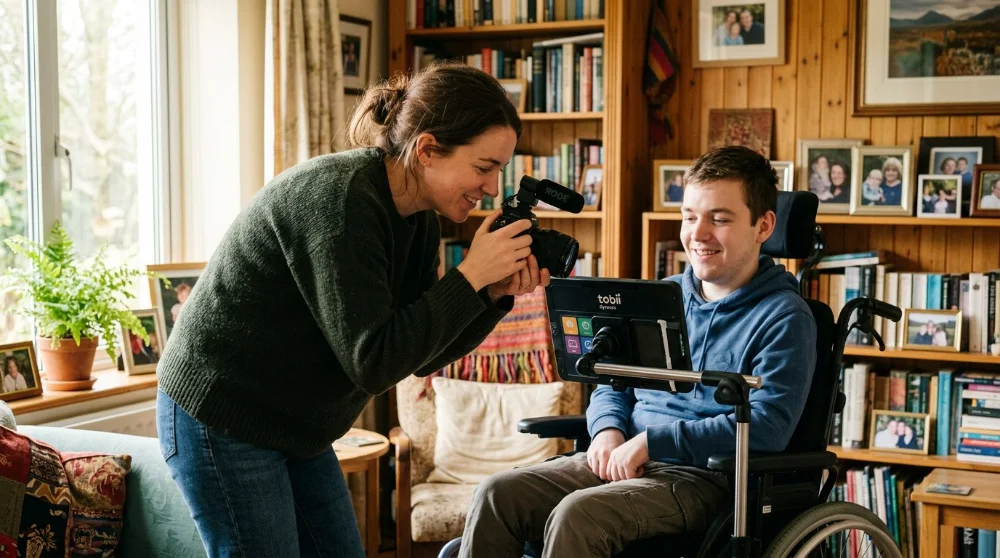
Her film Cabbage (2023) exemplifies this approach. An intimate work made in collaboration with her family, the film reframes language to illuminate relationships of care at its centre . It focuses on her brother David, who is non-verbal and non-mobile, and her mother, who serves as his primary advocate and voice. The film unfolds in the months leading up to an international move from Canada back to Ireland—a country they had left a decade earlier due to severe cuts in disability services .
What makes Cabbage so remarkable is its refusal to adopt a conventional documentary structure. There is no omniscient narrator, no explanatory voiceover. Instead, Parnell employs a non-linear framework, weaving together fragments of conversation, reflection, and the quiet, often overlooked details of care . David’s voice emerges through eye-gaze technology, a tool he uses creatively to write poetry and take photographs . The film is less a portrait of disability than an exploration of how a human life is measured and valued within an ableist paradigm .
As Parnell has noted, her work is drawn to “the in-between moments, the unfixed or the incomplete—these limbo spaces” . It is in these spaces, she suggests, that new meanings can emerge—something more sensory, more sublingual, more attuned to the complexities of lived experience.
III. The Politics of Language and Authority
At the heart of Parnell’s practice is a sustained inquiry into language and power. Her work asks: How do bureaucratic and institutional frameworks shape our understanding of human worth? How does voice—or its absence—determine agency and value?
In Cabbage, these questions are explored through the lens of family and disability. But they recur throughout her work, including her ongoing Desktop Compositions series, which uses digital interfaces—Instagram filters, YouTube tutorials, dating apps, and wearable eye trackers—as lenses through which to perceive shifting notions of bodily autonomy in contemporary life .
This engagement with language and authority extends to her broader practice. As she has described, her work often examines “the absurd way a human life gets measured and valued within language” . This is not an abstract concern; it is grounded in the specific, the personal, the lived. In this sense, Parnell’s work represents a significant departure from earlier generations of documentary filmmakers, who often positioned themselves as neutral observers. For Parnell, the filmmaker is an active participant, embedded in the relationships and dynamics being explored.
IV. A Broader Context: Irish Documentary’s Rich Tradition
Parnell is part of a broader wave of Irish artists working at the intersection of documentary and experimental practice. This is a tradition with deep roots, from the No Wave films of Vivienne Dick, whose work helped define a generation of feminist experimental filmmaking, to the formally audacious work of Pat Collins, whose Song of Granite (2017) blended fictional re-creation, archive footage, and musical performance to create an impressionistic portrait of folk singer Joe Heaney .
More recently, Ian Thuillier’s documentary Guggi (2026) has brought renewed attention to the possibilities of the artist portrait. Filmed over two years with unprecedented access, the film traces Guggi’s journey from the anarchic post-punk energy of 1980s Dublin to his quiet life as a painter. Yet it avoids the conventions of the traditional biography, offering instead a meditation on creativity, friendship, and resilience . As Thuillier has described it, his hope was “to make a film that went beyond the story of an artist and explored the deeper human need to create” .
What connects these diverse practices is a shared commitment to interrogating the very form of documentary itself. These are not films that simply present the world; they ask us to consider how we see, how we know, and how we value.
V. The Audience as Co-Conspirator
One of the most distinctive aspects of Parnell’s practice is her relationship with the audience. She is clear that her work is not designed to elicit a specific reaction: “You can’t control what people will feel or not. I just use my own reactions and feelings as a compass” .
Her ideal viewing experience is one of intimacy and accessibility—perhaps someone experiencing the work “in the palm of their hand through a phone, lying in their bed” . This is not a diminishment of the work; it is a recognition that the most profound encounters with art often occur in the quiet, unremarkable spaces of daily life. It is a sensibility that aligns with her interest in the fragmentary, the unfinished, and the present tense.
VI. A New Language for a New Reality
Holly Márie Parnell represents a vital new voice in Irish documentary practice. Her work, along with that of her contemporaries, signals a shift away from the traditional documentary’s claims to objectivity and toward a more reflexive, personal, and politically engaged mode of filmmaking.
Her approach—built from personal encounters, grounded in lived experience, and committed to interrogating the layers of language and authority through which we construct meaning—offers a model for a cinema of the real that is attuned to the complexities of contemporary life.
It is a cinema that does not pretend to offer answers, but instead invites us to ask better questions. And in doing so, it reminds us that the most powerful truths are often found not in the grand narratives we construct, but in the fragments, the in-between moments, and the voices that emerge from beyond the frame.